Analysis: Mother Russia’s ransomware variants - Patriotism for profit, killswitches and friendly fire

In this writeup, I’ll be sharing my knowledge on the modern day ransomware movement and the pioneers behind it. Grab a шашлык (basically a russian kebab from my knowledge, pronounced Shashlik), sit back and enjoy the writeup.
Track of the session: BONES, Xavier Wulf, Chris Travis - WeDontBelieveYou
Chapter I - Background
For around a decade now, hacking has become more and more financially motivated each year. With 2017 being the catalyst and motivator for many groups I would say, following the WannaCry outbreak in May 2017.
No one really hacks for fun, knowledge or to sharpen their skills anymore, we don’t have any more Gary McKinnons’ (absolute mad lad btw).
So, with ransomware being such a lucrative business model now, (yes, threat actors actually classify themselves as business operators, not criminals lol, i have seen this first hand, shoutout Maksim Yakubets)
You might be asking, who is the MVP, the key player in the industry? No one in particular, but a certain region dominates the industry, which is by far Russia.
However, I do side with the Russians, their name often tarnished for “hating the west” and constantly getting the blame for random cyberattacks that happen in and around the world day to day. Whilst yeah, to a degree some of it is true, the stereotype is quite narrowminded. A lot of big cyberatttacks especially in 2025, have been committed by english speaking geeks in their UK and USA bedrooms.
This doesn’t change their heavy presence in cybercrime today, as like I said they are one of the key players in Ransomware which I’ll now get into.
Chapter II - Patriotism for profit
In most Commonwealth of Independent States (former soviet nations), they tend to produce a large number of technically strong young people. In these regions, legitimate pathways are often limited, and as opposed to western regions like the USA & UK, the underground economy is visible, accessible and normalized. This means most cybercrime communities are easy to come by and aren’t hidden. Telegram is widely used in Russia, and is also used for communication and as general forums by threat actors.
As young actors explore this world, accompanied with the general Russian stance many grow up with on the west, they find that not only do Western organizations pay up the most, but law enforcement in those regions cannot directly arrest or extradite anyone based in Russia. Also, cross-border investigations are slow and politically restrained.
In Russian-language cybercrime spaces, forums and channels, attacking foreign entities is often framed as:
-
Less serious than domestic crime
-
Victimless and abstract
-
Comparable to exploiting “hostile” systems
This all originates from existing Russian stance on the west, and also probably the fact that they get blamed and tarnished for alot of stuff, so I guess it’s a big fuck you to the west most of the time. Fair play lads.
Chapter III - Friendly fire, killswitches and the rozzers.
Alright, it’s all well and good unloading attacks left, right and centre like Stevie Wonder has just got his hands on a Kalashnikov… but how do you avoid the Gulag? It’s a good question to ask, as these threat actors make absolute shed loads and authorities just turn a blind eye.
In most Russian ransomware if you reverse engineer it (I will cover some reverse engineering further down), a lot of functions will display things like checks for Russian locale Windows registry key entries, keyboard layouts etc. This is so they don’t pull an American Normandy and drop bombs on their own troops.
The malware will include a small killswitch function if it detects anything Russian or any where which is apart of the Commonwealth of Independent States (now excluding Ukraine). If and once this is detected, the malware will stop dead in it’s tracks, tie the rope and kick the bucket and perish as if it was never there.
How does this protect the actors? Well, it’s a form of self-policing. As previously mentioned, enforcement is only put in place by the MVD and FSB (Russian alphabet agency rozzers) when their own are hit. So, this allows them to operate comfortably without the worry of getting nicked, provided the malware actually works, otherwise it’s a long day and Uncle Vlad will be having a stern word.
Chapter IV - The killswitch
Alright, let’s get into it. I’ve pulled a REvil / Sodinokibi sample from MalwareBazaar, one of the most prolific ransomware-as-a-service operations to exist. Responsible for multiple ransoms against firms such as Kaseya, etc.
Sample details:
- SHA256:
133bf8be0cf7003b83b03579970997d408a930e58ec2726715140520900c06de - MD5:
77be32b91561d1ac5e36464766b7b0a7 - Architecture: i386 PE
A bit of history before we crack it open, because the context matters. REvil didn’t appear out of nowhere, it’s the direct successor to GandCrab, which was the dominant RaaS operation before it “retired” in 2019 after its operators claimed to have made over $2 billion. REvil picked up where GandCrab left off, same affiliate model, same target profile, significantly more aggressive.
At its peak REvil was responsible for some of the most disruptive ransomware attacks ever recorded. The Kaseya VSA supply chain attack in July 2021 was the big one. They compromised a remote management platform used by MSPs and pushed REvil to over 1,500 businesses downstream in a single hit. Demanded $70 million in Bitcoin for a universal decryptor. Absolute scenes.
Then in October 2021 law enforcement — a coordinated effort involving the FBI, Europol and several other agencies, took down their infrastructure and arrested several affiliates. REvil went dark. Everyone assumed that was that.
Then they came back. Hence the ransom note opening with “Welcome. Again.” — they knew exactly what they were doing with that line.
Before we crack open the binary, let’s run CAPA against it first. CAPA is a tool by Mandiant that analyses a binary and maps its capabilities before you even open a disassembler, think of it as a capability fingerprint. It’ll tell you what the binary can do and where, saving you from hunting cold in Ghidra.
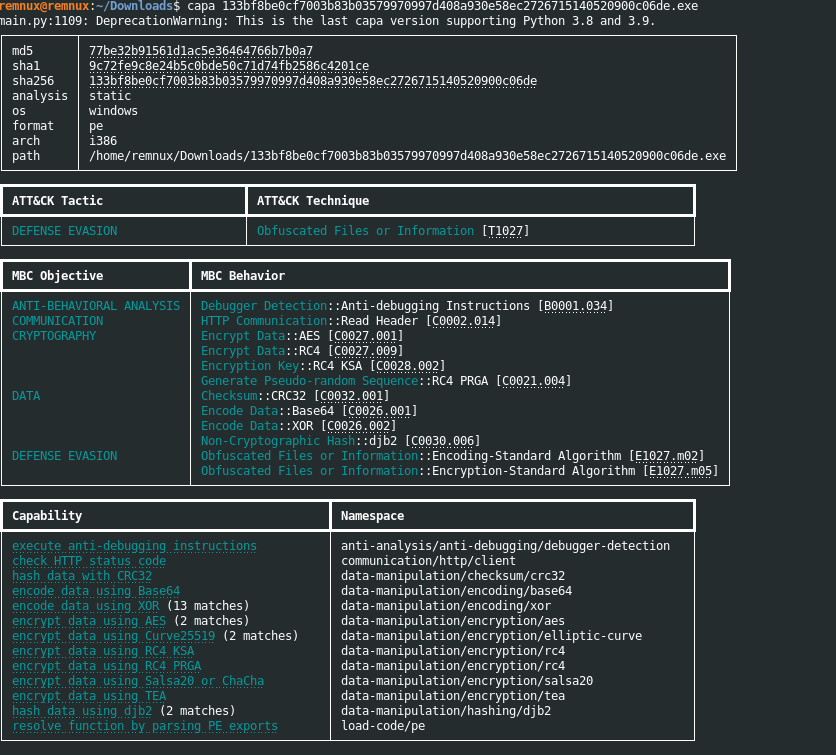
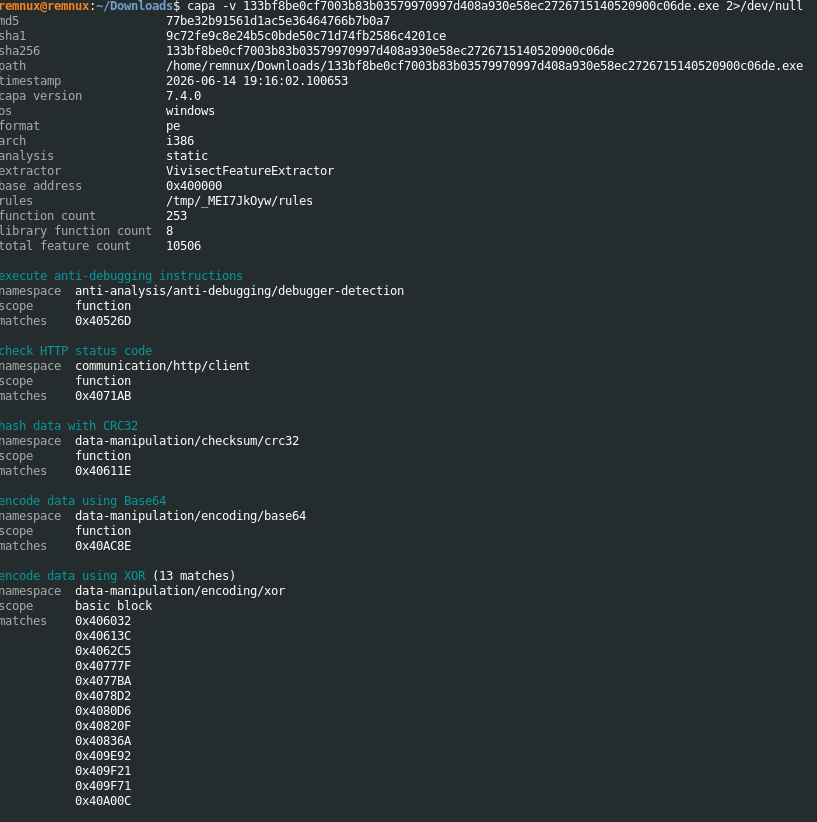
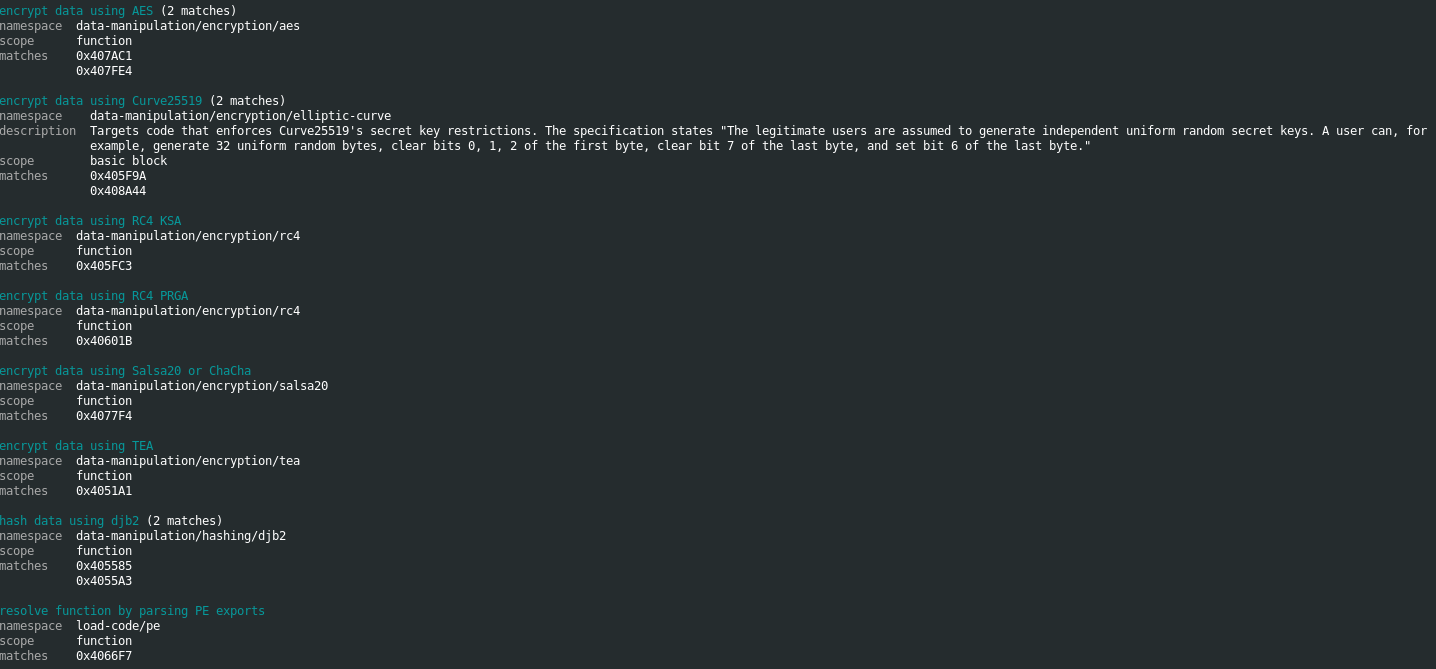
Straight away it’s telling us everything we need. RC4 encryption, CRC32, Curve25519, Salsa20, anti-debugging instructions, and crucially: resolve function by parsing PE exports. That last one is the API hashing we’ll get into shortly. No explicit locale check flagged, I’ll explain why in a moment.
First thing REvil does before it even thinks about touching a single file is run a geographic check. Lets find it.
Finding the killswitch - hunting 0x419
Open the sample in Ghidra and let auto-analysis run. Once complete, Search -> Scalar Values and search for 0x419. One result comes back:

That drops us straight into FUN_004043e2. Here’s what we’re looking at:
local_4c[0]  = 0x419;   // Russian
local_4c[1]  = 0x422;   // Ukrainian
local_4c[2]  = 0x423;   // Belarusian
local_4c[3]  = 0x428;   // Tajik
local_4c[4]  = 0x42b;   // Armenian
local_4c[5]  = 0x42c;   // Azerbaijani
local_4c[6]  = 0x437;   // Georgian
local_4c[7]  = 0x43f;   // Kazakh
local_4c[8]  = 0x440;   // Kyrgyz
local_4c[9]  = 0x442;   // Turkmen
local_4c[10] = 0x443;   // Uzbek
local_4c[11] = 0x444;   // Tatar
local_4c[12] = 0x818;   // Romanian (Moldova)
local_4c[13] = 0x819;   // Russian (Moldova)
local_4c[14] = 0x82c;   // Azerbaijani (Cyrillic)
local_4c[15] = 0x843;   // Uzbek (Cyrillic)
local_4c[16] = 0x45a;   // Syriac
local_4c[17] = 0x2801;  // Arabic (Syria)

uVar1 = (*DAT_00410094)();   // GetSystemDefaultUILanguage
uVar2 = (*DAT_004100c8)();   // GetUserDefaultUILanguage

while ((local_4c[uVar3] != (uVar1 & 0xffff) && (local_4c[uVar3] != (uVar2 & 0xffff)))) {
    uVar3 = uVar3 + 1;
    if (0x11 < uVar3) {
        return 0;  // not whitelisted, continue execution
      }
  }
return 1;  // whitelisted, bail out
18 hardcoded LANGIDs built on the stack. The two API calls: (*DAT_00410094)() and (*DAT_004100c8)() are GetSystemDefaultUILanguage and GetUserDefaultUILangauge, resolved dynamically at startup via function pointers. That’s why CAPA couldn’t tag this as a locale check. No named imports anywhere, just raw pointers in a global table populated at runtime.
Both return values get masked to 16 bits (& 0xffff) and compared against every entry. If either matches, whitelisted, malware exits. Exhaust all 18 without a match, execution continues and your files are getting encrypted.
A couple of things worth noting on this specific sample. Ukrainian (0x422) is in the list. This is a pre-2022 build. After the invasion, REvil builds quietly dropped Ukraine from the whitelist. Geopolitics written directly into the binary, brilliant. Also notice Arabic (Syria) at 0x2801. The only non-post-Soviet entry, almost certainly added at the request of a specific affiliate operating out of Syria.
Chapter V - Hiding from the rozzers (and the analysts)
Beyond the CIS check, REvil puts serious effort into making itself a nightmare to reverse engineer. Here’s what I actually found pulling this sample apart.
No import table - API hashing
Open the imports in Ghidra. Empty. Nothing in the IAT whatsoever. Every single Windows API call is resolved at runtime using a custom hash. CAPA flagged this as resolve function by parsing PE exports at 0x4066F7:
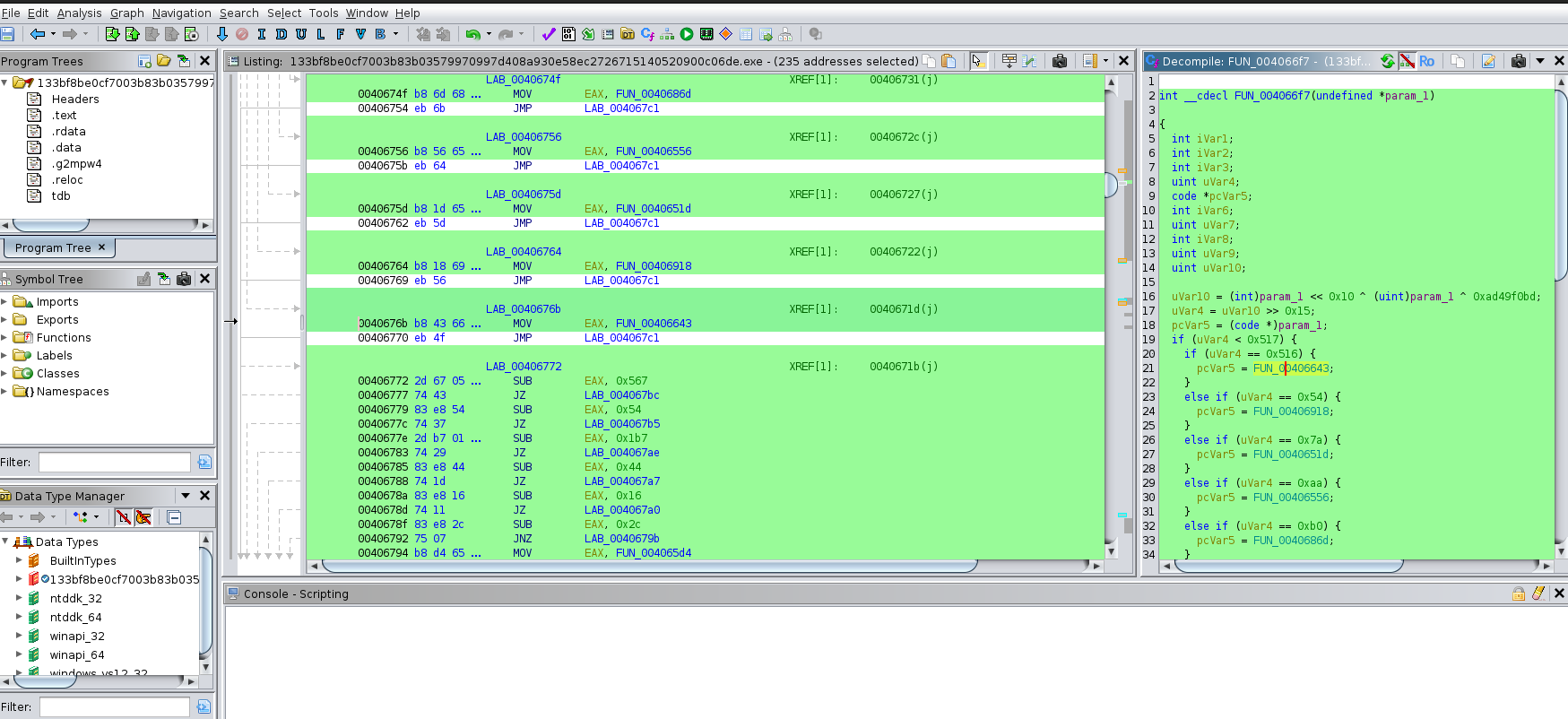
The resolver takes a hash value, XORs it with 0xad49f0bd, then uses the upper bits to select which DLL to search via a switch-case. Each branch returns a module base address. The lower 21 bits identify the specific function within that DLL:
uVar10 = (int)param_1 << 0x10 ^ (uint)param_1 ^ 0xad49f0bd;
  uVar4 = uVar10 >> 0x15;  // upper bits = DLL selector
Then it walks the PE export table. 0x3c to get e_lfanew, +0x78 for the export directory RVA, iterates through AddressOfNames, hashes each with djb2, then compares the lower 21 bits:
iVar8 = *(int *)(*(int *)(iVar6 + 0x3c) + 0x78 + iVar6) + iVar6;

if ((uVar7 & 0x1fffff) == (uVar10 & 0x1fffff)) {
    return function_pointer;
}
No import table means AV engines keying off API names find absolutely nothing. The locale check APIs are resolved this way too, hence why CAPA couldn’t detect the killswitch statically.
Anti-debugging - RDTSC timing loop
CAPA flagged anti-debugging at 0x40526D
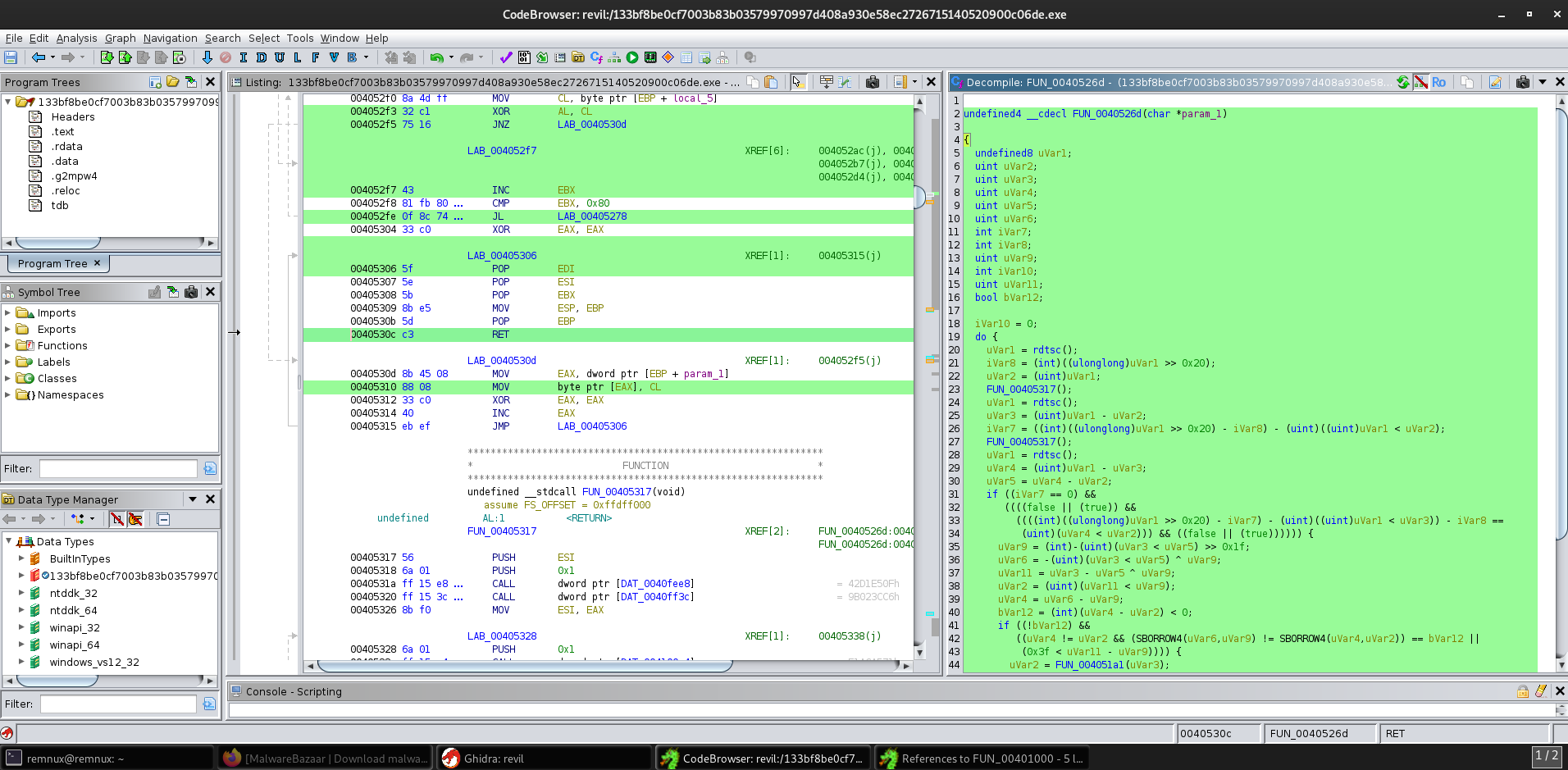
RDTSC is called three times, not two. It takes multiple timing deltas and cross-compares them for consistency. If you’re stepping through in a debugger the deltas blow out and it clocks you. When it detects a timing anomaly it doesn’t just exit, it feeds the delta values into the TEA encryption function (FUN_004051a1) and compares outputs. If they don’t match, it bails.
It also runs this check 128 times, (0x80 iterations). Not a one shot, repeated statistical sampling across the entire pre-execution phase. Patch the jump condition in x64dbg to get past it.
RC4 - config decryption and string obfuscation
CAPA confirmed RC4 KSA at 0x405FC3:
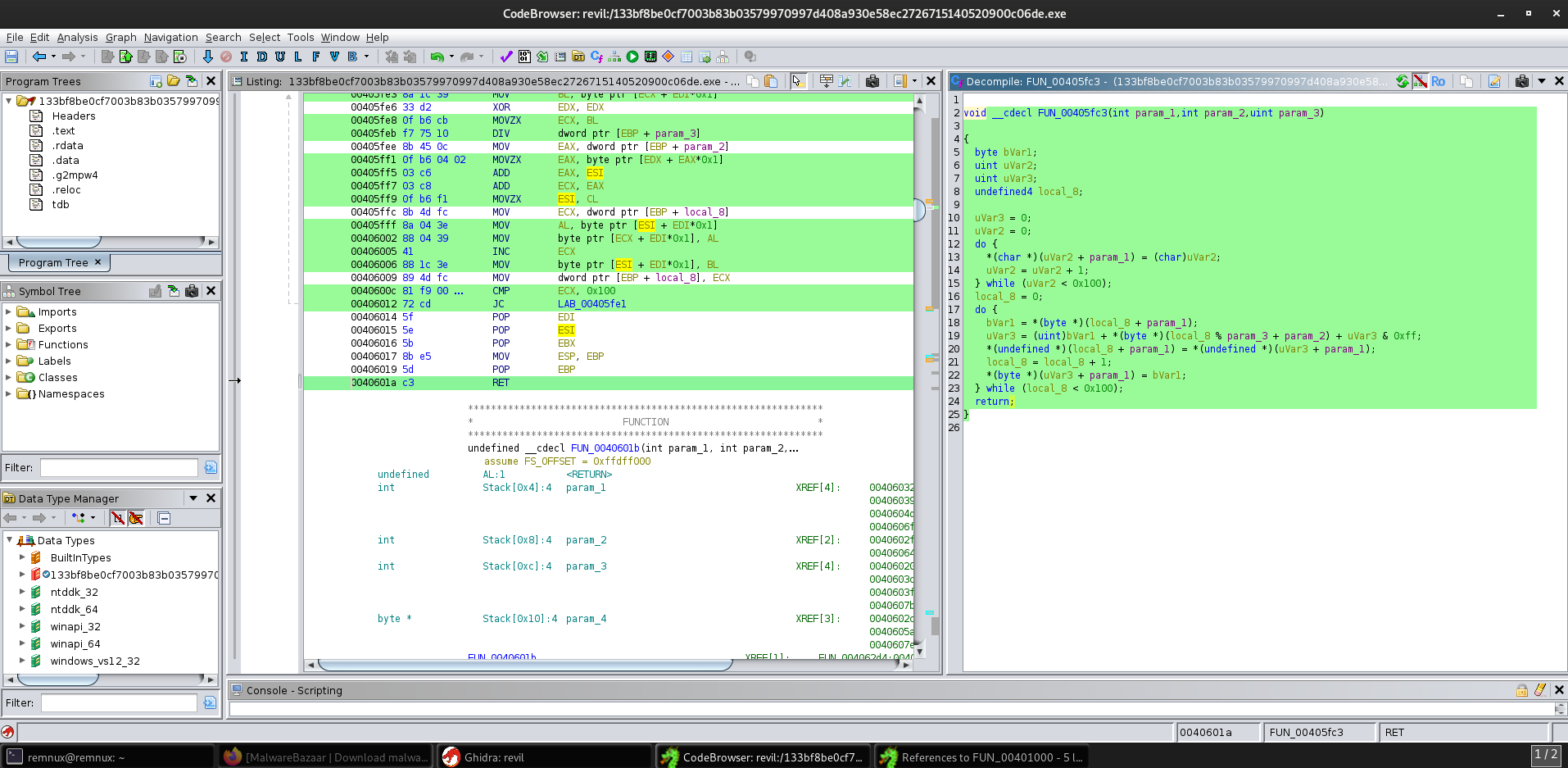
Textbook KSA - first loop initializes the 256-byte S-box with S[i] = i, second loop does the key mixing with the classic j = (j + S[i] + key[i % keylen]) % 256 swap pattern. RC4 is used for both config decryption and per-string obfuscation. Every string in the binary is encrypted with its own individual key stored alongside it in .data. No single key to extract, no bulk decryption shortcut.
The config - RC4 encrypted JSON in a custom PE section
All of REvil’s operational parameters live in an encrypted blob in a custom PE section. This sample uses .g2mpw4, visible in Ghidra’s program trees panel. Different builds use different names (.grrr, .zeacl etc.) to break signature detection.
Layout of the config blob:
Bytes 0x00–0x1F  (32 bytes):  RC4 key (plaintext)
Bytes 0x20–0x23  (4 bytes):   CRC32 of ciphertext
Bytes 0x24–0x27  (4 bytes):   Ciphertext length
Bytes 0x28+:                  RC4-encrypted JSON
Extract it with Python:
import pefile, struct
  from arc4 import ARC4

  pe     = pefile.PE("sample.exe")
  data   = pe.sections[3].get_data()
  key    = data[0:32]
  ct_len = struct.unpack('<I', data[36:40])[0] - 1
  ct     = data[40:40+ct_len]
  print(ARC4(key).decrypt(ct).decode())
Running that against the sample (used JSON to clear it up):
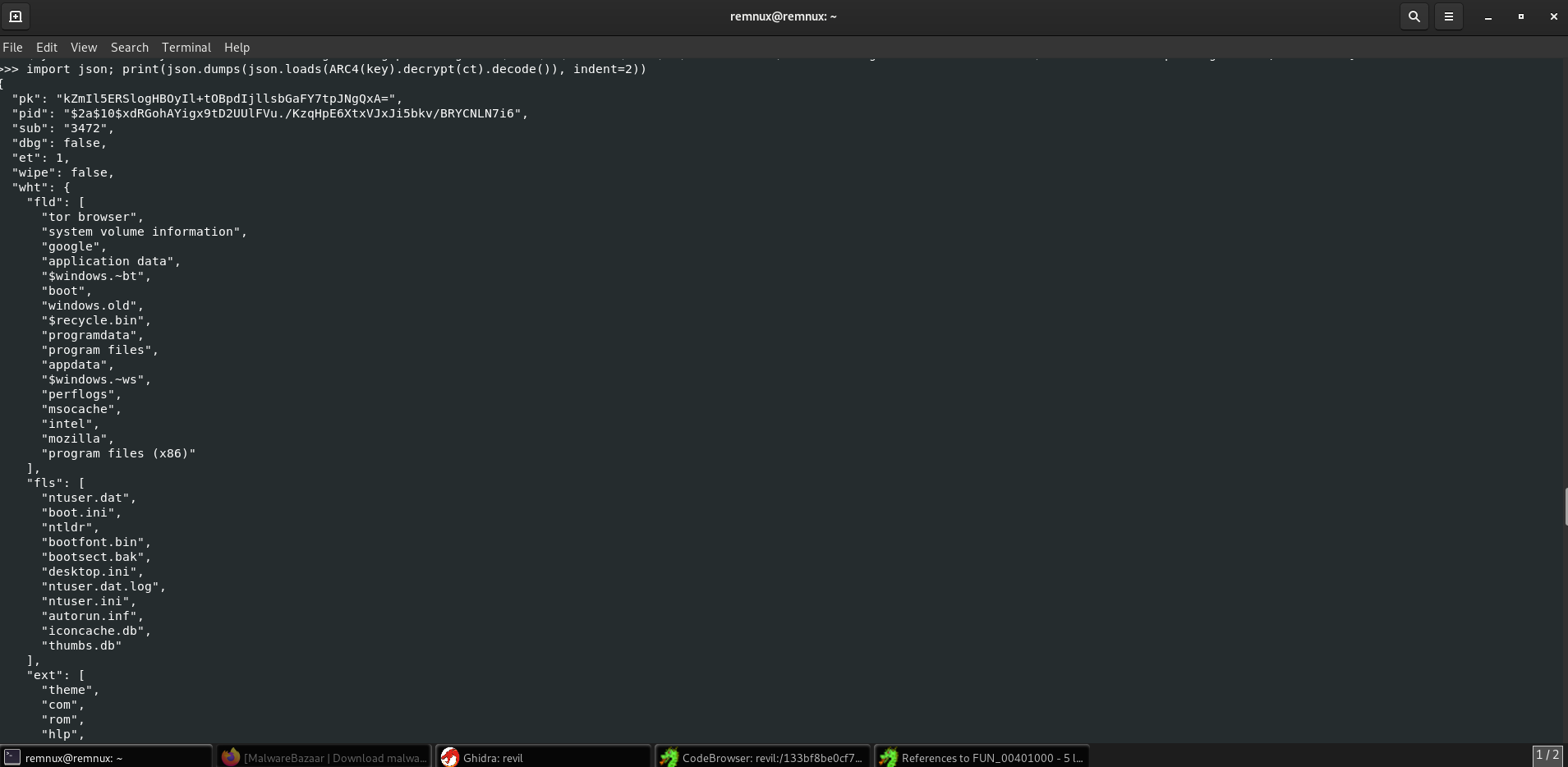
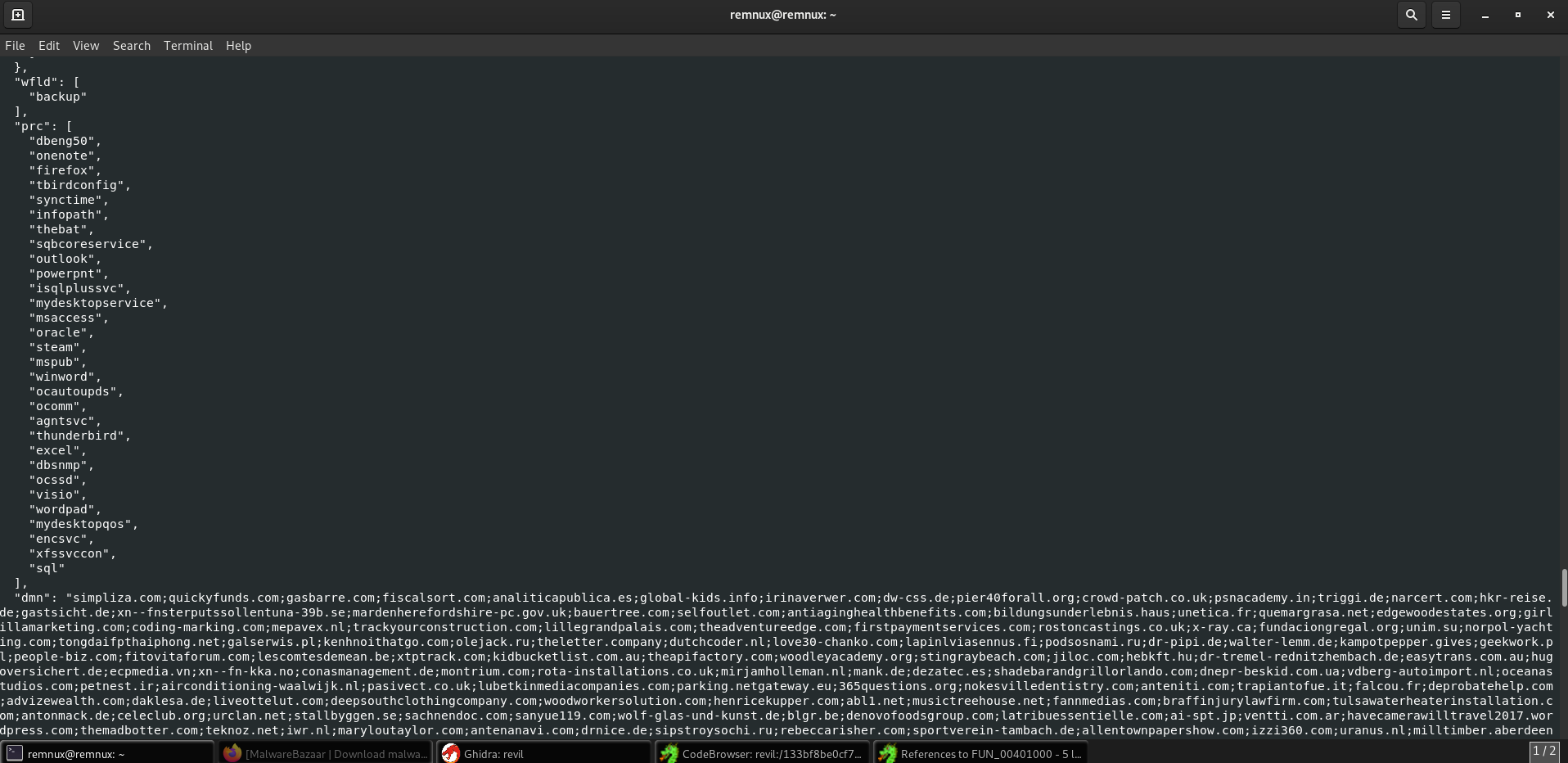
Key fields from this specific build:
svc — services killed before encryption:
backup, sophos, memtas, svc$, mepocs, vss, sql, veeam
Sophos gets the boot first. VSS (Volume Shadow Copy) goes too, that’s your Windows backup snapshots gone, no easy restore. Veeam is enterprise backup software. They’re not being sloppy here, they know exactly what they’re killing and why.
prc — processes killed before encryption:
winword, excel, outlook, powerpnt, msaccess, mspub, onenote,
infopath, visio, wordpad, thunderbird, firefox, thebat,
oracle, sql, dbeng50, steam...
The obvious ones — Office suite, email clients, database engines — are killed to release file locks so REvil can encrypt the documents they’re holding open. But Steam being on that list is interesting. This isn’t just targeting enterprise environments. They’re going after home users too, anyone with files worth encrypting. No discrimination whatsoever.
dmn — the C2 domain list runs to hundreds of entries. None of them are REvil infrastructure. They’re all compromised legitimate websites — florists, dentists, law firms, a Norwegian barging company, a Finnish nursery school. All hacked and injected with C2 code. The traffic from a victim machine beaconing out to woodleyacademy.org or nokesvilledentistry.com looks completely normal to a firewall. No purpose-built C2 to take down, no suspicious domains to block. Take one out, hundreds more in the list.
The ransom note (excuse poor formatting, pasted from base64 decode output) (nbody decoded from base64 UTF-16LE):
  ---=== Welcome. Again. ===---

  [+] What's Happened? [+]

  Your files are encrypted, and currently unavailable. You can check it: all files on your system has extension {EXT}.
  By the way, everything is possible to recover (restore), but you need to follow our instructions. Otherwise, you cant return your data (NEVER).

  [+] What guarantees? [+]

  Its just a business. We absolutely do not care about you and your deals, except getting benefits. If we do not do our work and liabilities - nobody will not cooperate with us. Its not in our interests.
  To check the ability of returning files, You should go to our website.
  There you can decrypt one file for free. That is our guarantee.
  If you will not cooperate with our service - for us, its does not matter.
  But you will lose your time and data, cause just we have the private key.
  In practice - time is much more valuable than money.

  [+] How to get access on website? [+]

  You have two ways:

  1) [Recommended] Using a TOR browser!
  a) Download and install TOR browser from this site: https://torproject.org/
  b) Open our website: http://aplebzu47wgazapdqks6vrcv6zcnjppkbxbr6wketf56nf6aq2nmyoyd.onion/{UID}

  2) If TOR blocked in your country, try to use VPN! But you can use our secondary website. For this:
  a) Open your any browser (Chrome, Firefox, Opera, IE, Edge)
  b) Open our secondary website: http://decryptor.cc/{UID}

  !!! DANGER !!!
  DONT try to change files by yourself, DONT use any third party software for restoring your data or antivirus solutions - its may entail damage of the private key and, as result, The Loss all data.
  !!! !!! !!!
  ONE MORE TIME: Its in your interests to get your files back. From our side,
  we (the best specialists) make everything for restoring, but please should
  not interfere.
  !!! !!! !!!
“Welcome. Again.” Cold as anything. They knew exactly what the law enforcement takedown meant and they came back anyway. The .onion address and decryptor.cc fallback are both long dead. This is an old build, but the note gives you a proper look at the victim-facing side of the operation. Note the tone: detached, transactional, almost customer service like. “Its just a business.” That lines up exactly with what was covered back in Chapter II about how these operators frame what they do.
Chapter VI - What can defenders actually do with this?
All of this is useful beyond just being interesting, there are concrete defensive takeaways from tearing a sample apart like this.
Hunt for the killswitch in your environment. If you’re a defender and you know Russian ransomware families check for locale settings, you can use that against them. Honeypot machines with Russian keyboard layouts or locale settings installed can cause some families to self-terminate on contact. It’s a genuine defensive technique, cheap to implement, and has been documented working against REvil and similar families.
VSS deletion is a high-confidence indicator. The svc list killing vss (Volume Shadow Copy) is one of the most reliable pre-ransomware signals you can alert on. Legitimate software almost never touches VSS from the command line. If you see vssadmin delete shadows or wmic shadowcopy delete firing on an endpoint, that’s ransomware prep, full stop. Get an alert on it.
The prc kill list tells you what to monitor. Any process that kills Word, Excel, Outlook, SQL Server and Veeam in rapid succession before doing anything else is not behaving normally. Process tree monitoring catches this pattern early, before encryption starts.
C2 over compromised legitimate domains is hard to block but not impossible to detect. The dmn field shows hundreds of benign-looking domains. You can’t blocklist them all without breaking legitimate traffic. But the beacon pattern — periodic HTTP requests to multiple external domains with consistent timing intervals — is detectable in network flow data. Look for the cadence, not the destination.
The config extraction script is a defender tool too. If you recover a REvil binary from an incident, run the config extractor before you do anything else. The sub and pid fields identify the affiliate who deployed it, the dmn list gives you the C2 infrastructure to hunt for in your logs, and the prc list tells you what processes the attacker expected to find running, which gives you a profile of the intended target environment.
If you’re this far, thanks for reading! Was a fun 2/3 hour session.